
Around the year 568, barbarian invasions brought with them herds of cattle with their distinctive red coats that had been stolen from the vast plains of southern Russia and Pannonia.
The monks who started making the forerunner of today’s Parmigiano Reggiano in the 12th century used these primitive cows as a point of reference. At the time, these cows had a threefold attitude and were distinct milk producers. The breed played a prominent role in the agricultural and zootechnical contexts of Reggio Emilia and Parma, but post-Second World War Italian zootechnical policy started crossbreeding to replace these cows with cosmopolitan breeds in order to pursue easier selection goals. There were fewer than a thousand cattle left by 1980. Since then, the quality of the milk and innovative valorisation techniques have contributed to a steady demographic comeback.
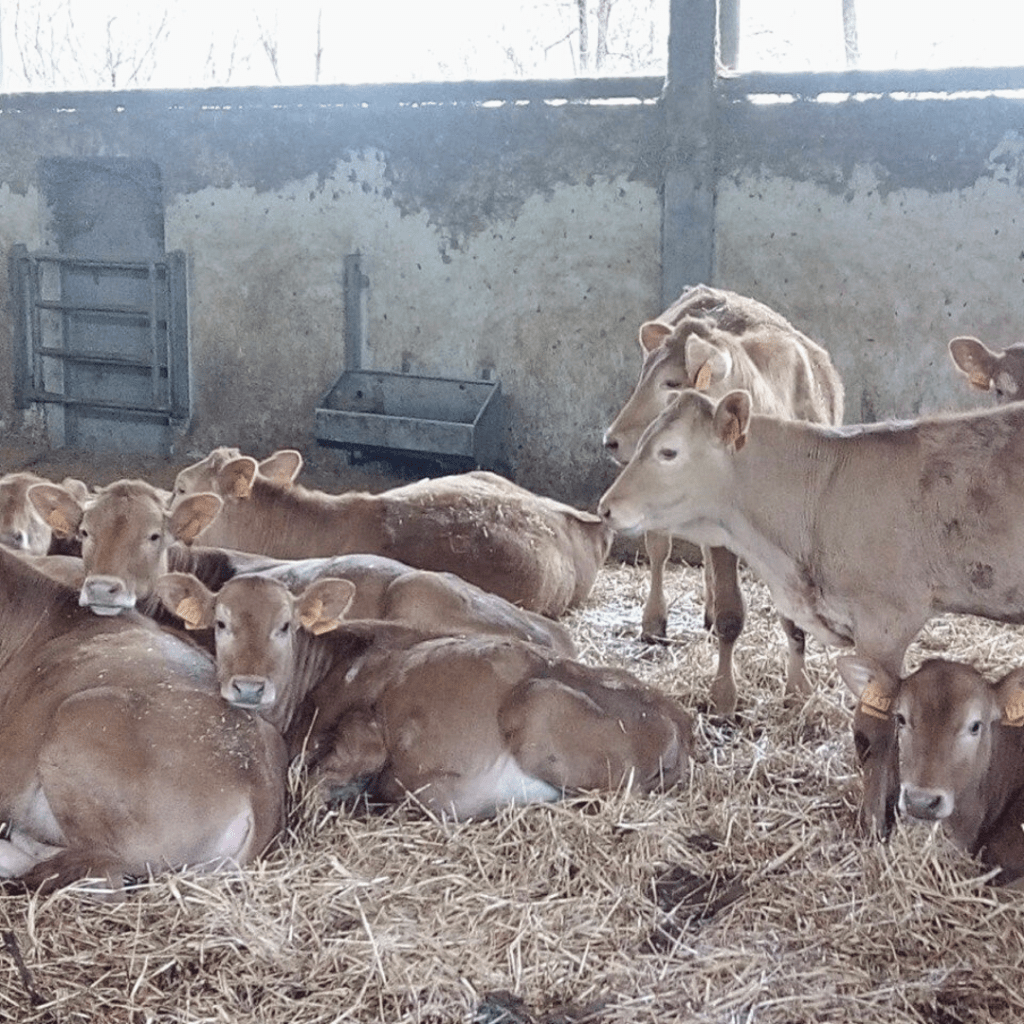
Today, the Reggiana is best suited for producing milk used to make Parmigiano Reggiano. For calves and animals in their later stages of life, the breed still exhibits good meat output, rusticity, and outstanding reproductive performance.
The breed is distinguished morphologically by a light to dark red coat that is more or less attenuated on the inner and lower portions of the limbs, around the eyes, and around the pink snout. The animals have a sturdy skeletal structure, a long trunk, a head that is consistently highly distinct, and good size.

TERRITORY
-
REGGIO EMILIA
Reggio Emilia is a city in northern Italy’s Po Valley that is situated on the Via Emilia and is bordered to the west by Parma and the east by Modena. Bologna is about 50 km away. The Po River separates it from the Mantua province to the north, while the Apennines form its southern boundary…

PRODUCT
-
PARMIGIANO REGGIANO RED COWS
Produced with milk from Red Cows of the Reggiana breed fed exclusively with NO GMO certified grass, hay and feed and with the absolute prohibition of any food technique that serves to force production, for the utmost attention to animal welfare. The milk of the Red Cows of the Reggiana breed has some qualitative characteristics…

